
Via Network protocol Overview
Learn about Via Network Protocol architecture and key system components.
Via Network protocol Overview
This section provides a comprehensive look at the overall architecture of the Via Network Protocol and the key components that drive its functionality.
What is a Rollup?
A rollup is a blockchain scalability solution that processes and stores transaction execution off‑chain, while ensuring data integrity and availability via anchoring to a secure base layer. In Via Network’s case:
- Execution and state transitions happen off‑chain, processed by a decentralized verifier network.
- Data availability is maintained via a specialized data availability layer.
- Final state commitments are anchored on the Bitcoin blockchain, leveraging Bitcoin’s security and decentralization.
Why and How It Works
Bitcoin’s base layer offers strong security but limited throughput. By moving computation and state updates off‑chain, Via Network can support higher transaction volumes and faster finality for users, while still inheriting Bitcoin’s security via periodic anchoring. The rollup model allows:
- High throughput: many transactions are processed off‑chain.
- Strong security: final state is committed to Bitcoin, and data availability ensures state can be reconstructed if needed.
- Decentralized verification: the verifier network (once fully launched) ensures correctness without relying on a single central party.
Via Network Components
Via Network protocol is made up of the following key components:
- Sequencer: Component that is responsible for receiving and processing user transactions, maintaining the off-chain state, and aggregating transactions into batches. It also integrates the Proposer, making it responsible for submitting transaction data to Data Availability (DA) layer and inscribing relevant data onto the Bitcoin network.
- ZK Circuits: Mathematical constructs that represent verifiable computation logic.
- Prover: Component that constructs the cryptographic proofs to attest to the correctness of the transactions processed off-chain. These proofs are later verified by the participants of the Verifier Network.
- Prover Gateway: Component (part of the Prover) that acts as an intermediary between the Prover and the Sequencer.
- Celestia Node: Celestia Light Node used as a way to interact with Celestia Network that is our DA layer.
- Bitcoin Node: Component used for interacting with the Bitcoin Network that is our settlement layer.
- Verifier Network: The main responsibility of the Verifier network participants (Verifier Nodes) is ZK proof verification and processing user withdrawals.
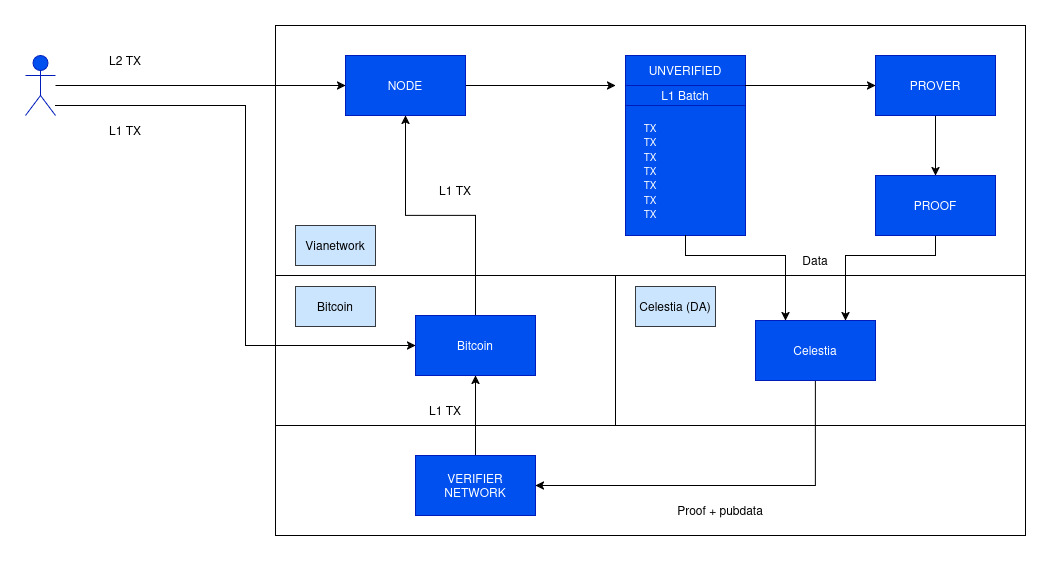
The Prover, ZK Circuits, and Prover Gateway implementations are fully inherited from the ZKsync protocol. For more details, please refer to the official ZKsync documentation.
To gain a deeper understanding of the core functionalities that underpin the Via Network Protocol, please refer to the following sections.